
Article
Food-Grade Silicone vs Plastic: What's Safer for Baby?
20 Nov 2026
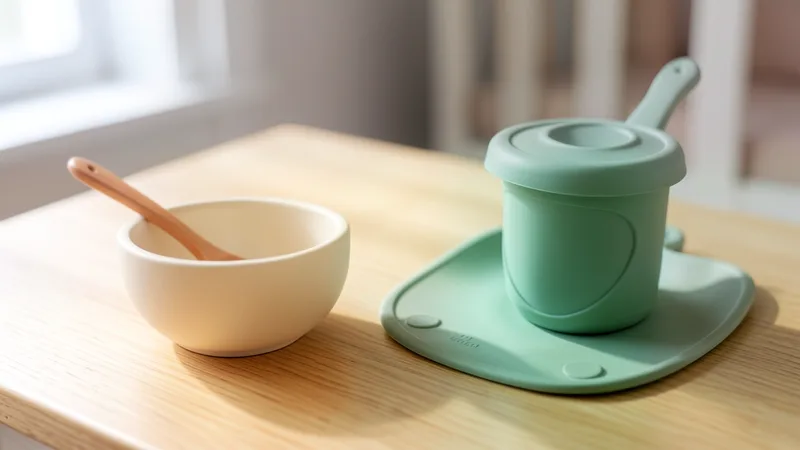
Both food-grade silicone and food-grade plastic are materials that food-contact rules in many countries allow to touch food. Both can be "safe" in the sense of being assessed — but their strengths differ: silicone is far more heat-resistant and contains no BPA, while plastic comes in many grades, prices and designs, and you need to check which temperatures a given grade is designed for.
What is food-grade silicone?
Food-grade silicone is a polymer of the polysiloxane family, whose chemical backbone is a chain of silicon–oxygen (Si–O) bonds, unlike the carbon backbone of plastics. That strong Si–O bond gives silicone high thermal stability across everyday temperatures — from the fridge to boiling and sterilising — without losing its shape or releasing odours.
The other difference is chemistry: silicone contains no BPA (bisphenol A) and no phthalate plasticisers — additives that can be found in some plastics such as polycarbonate and PVC.
"Food-grade" is not a single universal standard number. It is a claim that the material was made and tested under the food-contact rules of the market it is sold in. The manufacturer must be able to show a Declaration of Compliance under the EU's Regulation (EC) No 1935/2004 framework, and in Thailand products are supervised by the Thai FDA (อย.).
Plastic can pass the rules too
Plastic containers are not something to fear. Many plastics are manufactured to food-contact standards — for example, polypropylene (PP), a common food-contact plastic. Each market sets its own rules:
- EU — Regulation (EU) No 10/2011 uses a positive list: only substances listed in it may be used, with an overall migration limit of 10 mg/dm²
- US — 21 CFR Part 177 sets the requirements for food-contact material groups, such as 177.2600 for rubber articles intended for repeated use, which covers silicone
- Thailand — the Thai FDA (อย.) sets requirements for food-contact items, such as the B.E. 2565 (2022) Ministry of Public Health Notification No. 435 for plastic food packaging
The big recent issue is BPA. In 2011 the EU banned BPA in infant feeding bottles, and in 2018 extended the ban to drinking cups for young children. In 2023, EFSA — the EU food-safety authority — re-evaluated BPA and cut the tolerable daily intake (TDI) by 20,000-fold to just 0.2 ng/kg body weight per day, concluding that real dietary exposure may exceed this level. The result: Commission Regulation (EU) 2024/3190, in force since 20 January 2025, prohibits BPA in almost all food-contact material groups — plastics, coatings, rubbers and even silicones — with a transition period for existing products until 20 July 2026.
So in the EU after 2025, "BPA-free" is not a marketing claim but a legal requirement — and it is one reason many baby tableware brands have moved to silicone.
Comparing: silicone vs plastic
- Heat — silicone is far more heat-resistant: boiling, sterilising and dishwashers are fine (per the maker's instructions). Plastic tolerates only the temperatures stated on its label.
- BPA — silicone has no BPA by nature; with plastic, check the grade: polycarbonate (PC) contains BPA, while PP and PE do not.
- Weight — most plastics are lighter, which matters for things you carry around.
- Variety — plastic comes in more colours and shapes and is often the more accessible price point.
- Durability — silicone does not go brittle, does not fade easily and keeps its shape; plastic can scratch, stain or become brittle with heat and light over time.
How to choose baby items safely
- Look for the claim — products should say food-grade or food-contact, with a traceable manufacturer; for goods sold in Thailand, check the label meets Thai FDA requirements.
- Read the BPA story — "BPA-free" is always good, but in the EU BPA is now banned in (almost) all food-contact materials; in other markets it is still a maker's claim, so pair it with food-contact standards.
- Check heat markings — cups or bowls that meet hot food or a microwave should clearly state they are heat-resistant.
- Follow care instructions — most silicone can be dishwashed and boiled for sterilising; plastic follows the label. Avoid sharp objects on the surface.
- Inspect the surface — discolouration, peeling or a sticky surface = time to replace, in both silicone and plastic.
- Smell — a new product with an unusually strong chemical smell should be washed first; if the smell persists, stop using it.
FAQ
Is silicone always safer than plastic? Not always — both materials can pass food-contact rules. Silicone wins on heat resistance and has no BPA, but some plastics, such as PP, are safe and well suited to specific jobs.
Can silicone go in the microwave? Most food-grade silicone tolerates microwave-level heat, but always follow the maker's instructions.
What does BPA-free mean? It means BPA is not used in manufacturing. Since 2025 the EU has banned BPA in (almost) all food-contact materials, but in other markets it is still a maker's claim — pair it with food-contact standards.
How long does silicone last? There is no fixed standard lifespan — as long as the surface is undamaged, unfaded and not sticky, it can keep being used.
How do I know a product meets the standards? Check the manufacturer's information for the rules or standards it follows, and for goods sold in Thailand, check compliance with Thai FDA requirements.
Find baby items at The Little Store
The Little Store carries baby items and feeding accessories from carefully selected brands — if you are unsure about a product's material, ask our staff or the manufacturer directly. For Thailand's rules on baby products that contact food, read on in Thai rules for baby products: TISI, Thai FDA and labelling.
References
- Regulation (EU) No 10/2011 on plastic materials and articles intended to come into contact with food — EUR-Lex (European Union)
- Commission Regulation (EU) 2024/3190 on bisphenol A and other bisphenols in food contact materials — EUR-Lex (European Union)
- Re-evaluation of the risks to public health related to the presence of bisphenol A (BPA) in foodstuffs (plain language summary) — EFSA (European Food Safety Authority)
- 21 CFR 177.2600 — Rubber articles intended for repeated use — U.S. eCFR (U.S. Food and Drug Administration)
- ภาชนะบรรจุที่ทำจากพลาสติก — อย. (Thai FDA)